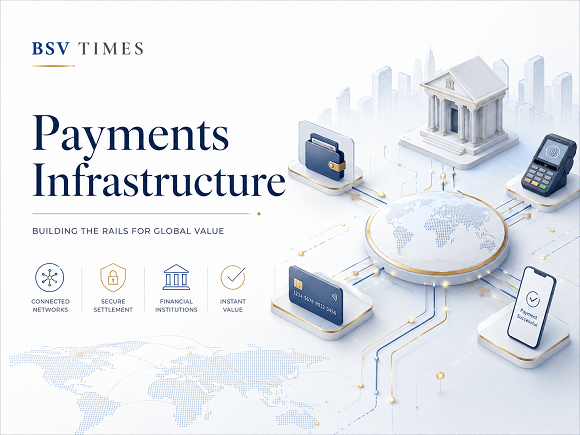
Mobile Wallet Watch / Payments Infrastructure
In Brief
BSV Association has released BSV Wallet on Google Play, bringing a new self-custodial mobile wallet to Android with three payment routes: nearby device-to-device payments, MessageBox/PeerPay handles and conventional BSV addresses. The wallet keeps its keys on the user’s device and can also pair with external applications through BRC-100-based wallet authorization. Its public source repository includes offline nearby transport, local wallet storage, recovery tools, BEEF transaction handling and an optional YubiKey-backed Vault. Store-index data records the Android release on September 6, 2026.
News Report
BSV Association has released BSV Wallet for Android through Google Play, providing a self-custodial mobile wallet centered on payments, key management and application authorization.
The Android store listing, indexed with a September 6 release date, identifies BSV Association as the developer and describes BSV Wallet as an open-source, standards-based wallet whose keys are generated and stored on the user’s device.
The public source repository describes the application as a self-custodial BSV payments wallet for iOS and Android, built with React Native and Expo. Its Android application identifier is org.bsvassociation.wallet. Public store availability currently confirmed by BSV TIMES is for Android.
The product is easier to understand by distinguishing it from BSV Browser.
BSV Wallet is a self-custodial mobile wallet centered on payments, key management and BRC-100 application authorization. Unlike BSV Browser, it does not include a web-browsing environment. The repository states that there is no separate browsing mode: the application opens directly into the wallet, with balance, Pay, Get paid, Vault and activity functions.
That does not make BSV Wallet a simpler send-and-receive wallet in the traditional sense. It can also act as the user-controlled wallet layer for external applications.
Three Payment Routes
BSV Wallet brings three payment methods behind the same Pay interface.
Users can pay through a MessageBox/PeerPay handle, transfer directly to a nearby device, or use a conventional P2PKH BSV address. The same general routes can be used when receiving payments.
The nearby-payment mechanism is the most unusual of the three.
According to the source repository, Local Payments use Apple Wireless Direct Link, or AWDL, on iOS and Nearby Connections on Android to transfer transaction information directly between nearby phones without requiring an internet connection between the two devices.
Transactions created while offline can be queued and later delivered or internalized once the required transport becomes available again.
This should not be interpreted as the BSV Blockchain itself operating offline.
The local connection allows the payment interaction and transaction data to move between nearby devices without normal internet access. Blockchain submission and subsequent processing still require connectivity to BSV network infrastructure.
In practical terms, the wallet separates creating and handing over the payment transaction from submitting it to the wider network.
A Wallet That Applications Can Connect To
BSV Wallet can also pair with external applications.
The store description says a user can scan a pairing code from a desktop or web application and approve requests from the phone using the BRC-100 wallet interface. BRC-100 itself defines a vendor-neutral interface through which applications can request wallet operations without being built around one particular wallet vendor.
The public BSV Wallet repository provides more detail.
It accepts bsv-wallet://pair and bsv-browser://pair deep links and establishes an encrypted relay-based RPC connection between the wallet and the requesting application. The paired interface currently exposes a subset of BRC-100 operations, including transaction creation and signing, public-key requests, certificates, encryption and decryption, and signatures.
Importantly, pairing does not give an application unrestricted permanent access.
The repository says each operation continues through the wallet’s permission system. An external application can therefore request an action, while the wallet remains responsible for deciding whether that request is permitted.
This illustrates the architectural role of BRC-100: an application can ask the wallet for cryptographic or transaction functions without becoming the wallet itself.
Keys Stay With the User
The wallet is self-custodial.
Its root wallet is derived from a BIP-39 mnemonic, while the mnemonic is kept using the device’s secure-storage facilities. Transaction and wallet state are stored locally using SQLite.
The store description emphasizes that keys are generated on the device and do not leave it. Device biometrics can be used as part of the unlocking experience.
For recovery, the wallet provides the familiar 12-word recovery material as well as printable recovery shares.
The store description says users can produce three recovery sheets, any two of which are sufficient to reconstruct the wallet. It identifies this scheme with BRC-157.
The source project also provides wallet-database import and export.
That additional capability matters because recovering the cryptographic root key and recovering the complete operational state of a wallet are not necessarily identical tasks. Database backup can preserve information beyond the mnemonic itself.
BEEF, BRC-42 and Configurable Infrastructure
The store listing describes BSV Wallet as SPV-native, using BEEF for lightweight transaction verification.
It also identifies BRC-42-derived keys, allowing wallet interactions with different counterparties to use derived keys instead of depending upon a single repeatedly reused key or address.
At the infrastructure level, the source project includes background monitoring through ARC server-sent events. If the application has been suspended, missed transaction-status events can be retrieved when it returns to the foreground.
Network services are configurable rather than permanently fixed to one endpoint. The project exposes settings for ARC and ChainTracks infrastructure and supports mainnet, testnet and Teratest configurations.
That is relevant for an open wallet implementation because applications and users need not treat one infrastructure provider as part of the wallet protocol itself.
Optional Hardware-Backed Vault
The public source tree also contains an optional YubiKey-secured Vault.
The architecture places a separate spending key behind compatible YubiKey hardware. The implementation uses NFC on iOS and USB/CCID on Android, with dedicated enrollment, recovery and transfer flows.
This creates a distinction between the wallet’s normal on-device key environment and funds deliberately moved behind external hardware protection.
The current Android store description does not prominently document the YubiKey capability, so its presence in the source repository should be distinguished from features independently described by the store listing.
BSV Wallet and BSV Browser Serve Different Interfaces
BSV Association now has two mobile products whose functions overlap but whose interfaces are notably different.
BSV Browser combines a browser, a self-custodial wallet and a BRC-100 environment. Websites opened inside its WebView can request wallet functions such as transactions, identity operations and cryptographic services, subject to user permissions.
BSV Wallet removes the browsing environment from that arrangement.
It opens as a wallet. The user can pay, receive, manage keys and permissions, and connect external applications to the wallet when those applications require BRC-100 capabilities.
That distinction is more meaningful than describing one product simply as a “dedicated” or “standalone” wallet.
Both are wallets.
The architectural difference is where the application runs.
With BSV Browser, the browser and wallet environment are brought together inside one application. With BSV Wallet, an external application can remain separate and communicate with the user’s wallet through the BRC-100 interface.
Android Release Confirmed
The BSV Wallet project itself targets both iOS and Android and includes build infrastructure for both platforms.
The public release BSV TIMES can presently confirm is Android.
A store index records BSV Wallet by BSV Association as released September 6, 2026, under the Finance category, and reproduces the Google Play product description and screenshots.
BSV TIMES has not yet confirmed a corresponding public App Store listing for this separate BSV Wallet application. The Android release should therefore not be presented as a completed simultaneous Android-and-iOS rollout.
BSV TIMES Read
There is a deceptively simple idea behind this release: the wallet does not have to be the application, and the application does not have to hold the wallet.
A user can keep keys, transaction state and authorization inside BSV Wallet while another application performs an entirely different job.
When that application needs a payment, signature, public key, certificate or encryption operation, it can request the capability through BRC-100. The wallet remains the boundary through which the user controls access.
That becomes particularly important if BSV applications are eventually expected to become ordinary software whose users do not think much about blockchain infrastructure.
Developers should not need to build a new custody system into every application. Users should not need to move their keys into every service they want to use.
A common wallet interface allows those responsibilities to remain separate.
The nearby-payment mechanism adds another dimension. Two phones can exchange the information needed for a payment locally, without depending on internet connectivity at the moment they meet, while blockchain delivery can occur once connectivity becomes available.
Neither capability changes the underlying BSV protocol.
Instead, they change how applications and people reach it.
That is what makes the Google Play release more significant than the repository activity BSV TIMES previously observed. The architecture is no longer only visible in source code. A BSV Association wallet built around payments, self-custody and application interoperability has now reached public Android distribution.
The next useful thresholds will be practical ones: an iOS release, wider documentation, third-party applications pairing with the wallet in normal use, and evidence of how offline nearby payments behave outside development and testing environments.
Source Links
BSV Wallet — BSV Association GitHub Repository
BSV Wallet — Public Project Site
BSV Wallet — Store Index Record
Posted on September 13, 2026

Leave a comment