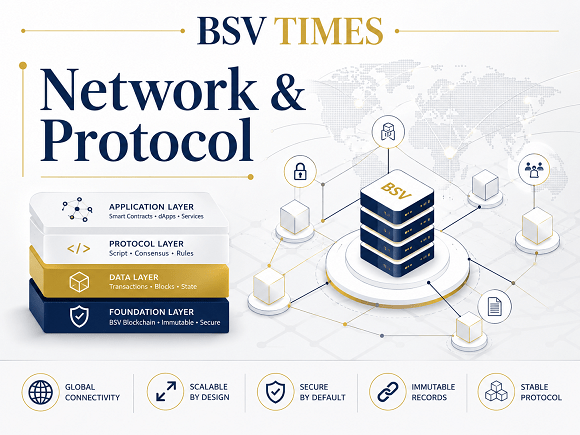
Network Infrastructure Watch / Network & Protocol
In Brief
Teranode has published v0.16.0-beta-14, a new pre-release strengthening transaction-validation safeguards, controls over peer-supplied requests and operational monitoring.
Released September 25, the build follows beta 13 with additional security corrections, optional filtering of peer messages and a block-assembly health check designed to detect a stalled processing loop.
The release also requires Go 1.27 when building from source. Its release notes state that container images are unaffected by that toolchain requirement.
News Report
Teranode’s latest beta brings another group of infrastructure changes into a tagged release for testing. The principal developments concern how services handle untrusted input and how operators detect problems inside a running node.
Validation Options Restricted at the HTTP Boundary
One correction removes the ability for unauthenticated HTTP callers to select validation options that bypass checks.
The accompanying pull request says the transaction endpoints no longer accept validation options or a block height through query parameters. Protobuf requests carrying non-default validation options are rejected, while the client also refuses to send those options through its HTTP fallback.
The change additionally constrains the outpoint-only validation path using the node’s own chain tip, reducing reliance on the height asserted by a caller.
These are implementation safeguards around validation. The pull request also identifies remaining follow-up work, including stronger validation provenance and handling of unusually large transactions in some configurations.
Peer-Supplied URLs Receive Additional Checks
A separate correction addresses requests derived from URLs supplied by network peers.
The developer’s account describes an audit finding in which URL construction and changing DNS answers could direct a request toward an internal service. The revised implementation constructs URLs from parsed components, rejects inappropriate components in peer base URLs and applies private-address restrictions when establishing connections.
Redirect handling is also tightened, including refusing redirects for POST requests.
For operators, the change makes configuration relevant: deployments intentionally communicating with peers over private addresses need the corresponding setting enabled. The pull request describes automated tests and explicitly states that it was not tested on a deployed node.
Optional Filtering of Peer Messages
Beta 14 introduces an optional publisher allowlist through the p2p_allowed_publisher_ids setting.
When enabled, it filters messages according to their authenticated author’s peer ID. Messages from outside the configured set are neither delivered to local subscribers nor forwarded through the messaging mesh.
The setting is empty by default, leaving existing behavior unchanged unless an operator enables it. Connections themselves remain intact, and excluded authors are not automatically banned or penalized.
The documentation notes operational consequences: filtering also covers status messages, so a connected peer can disappear from monitoring displays. Restricting forwarding can also affect the filtering node’s own message-delivery score.
Detecting a Stalled Block Assembler
Another addition allows the block-assembly liveness check to identify a processing loop that has stopped responding.
Its heartbeat tracks whether the loop can still run, including during idle periods. This helps distinguish a stalled service from a healthy node with little activity.
The feature is optional. Operators must choose a timeout that accommodates legitimate long operations, and the effect of a failed health check depends on deployment: a separately hosted service and a node running all services in one process have different restart boundaries.
Other Release Changes
The release includes corrections to coinbase validation, block-announcement timing and blockchain database consistency. It also reduces unnecessary UTXO-store reads and adds or updates Grafana dashboards for latency, subtree validation, block assembly and other services.
GitHub identifies v0.16.0-beta-14 as a pre-release. Its publication establishes a new software-testing milestone; deployment decisions remain separate.
BSV TIMES Read
The practical significance of this release lies in the relationship between capacity and dependable operation.
A service-based node must control what information crosses each interface. Operators also need health signals that reflect whether processing is actually continuing, together with clear explanations of how optional controls affect connectivity and monitoring.
Beta 14 develops those operational foundations. Its value should be assessed through testing of the safeguards, configuration changes and recovery behavior in real deployments. Those are essential parts of making high-capacity infrastructure usable over time.
Source Links
Teranode v0.16.0-beta-14 — Release Notes
Validator HTTP Safeguards — Pull Request #1781
Peer URL and Private-Service Protections — Pull Request #1749
Optional Peer Publisher Allowlist — Pull Request #1786
Block-Assembly Liveness Detection — Pull Request #1493
Posted on September 25, 2026

Leave a comment