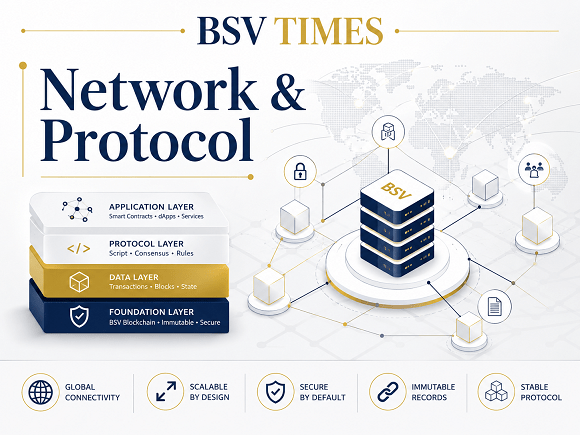
Network & Protocol / Scaling & Teranode
In Brief
A community-organized transaction test on October 31, 2026, generated substantial activity on BSV Blockchain, including a confirmed mainnet block containing more than 5.37 million transactions. Bridget Doran’s BSV Intel report recorded 47.24 million transactions across a reporting window extending into November 1, while participants described high-volume broadcasting from their own equipment.
The large block is independently visible on a public explorer. The individual broadcasting rates and broader test conditions remain participant-reported rather than independently measured network-wide performance.
New Report
The October 31 BSV Blockchain community transaction test produced one of its clearest measurable results when block #973563 was mined with 5,374,368 transactions.
The block was confirmed on November 1 at 03:54:23 UTC. BananaBlocks identifies the mining operator as SA100 and records a block size of approximately 1.39 GB.
The figures provide a publicly verifiable example of several million transactions being included in a single BSV Blockchain mainnet block.
Bridget Doran subsequently published an edition of BSV Intel covering 144 blocks between October 31 at 11:57 UTC and November 1 at 10:29 UTC. Her scanner counted 47,241,880 transactions during that approximately 22.5-hour period.
The reporting window covers the latter portion of the community test but also includes activity beyond October 31. Its total should therefore be understood as a measurement of blockchain activity during that window, not an independently isolated count of transactions produced exclusively by test participants.
What the Throughput Figures Show
Bridget’s report calculated an average of approximately 583 transactions per second across its observation window.
The busiest hour contained approximately 6.34 million confirmed transactions, corresponding to an estimated average of 1,762 transactions per second.
These figures are calculated from transactions recorded in blocks. For the hourly estimate, the report distributes each block’s transactions across the time since the preceding block.
This provides a useful way to estimate transaction activity over time, but it does not directly measure the precise moment each transaction entered the network.
Separate observations came from community participant Casey, who reported successfully broadcasting approximately 2,500 transactions per second for more than 30 minutes and briefly reaching 4,500 transactions per second.
Casey said the higher-rate burst ended when the wallet being used ran out of available funds.
Those observations describe the participant’s transaction-broadcasting experience. The available reports do not establish how many of those particular transactions were subsequently confirmed or precisely how they moved through the network.
Monitoring Under Heavy Load
The test also exposed a limitation in one of the tools used to monitor BSV Blockchain.
Bridget reported that block #973563 exhausted the available memory of her peer-to-peer blockchain scanner. She subsequently corrected the problem.
BSV Intel uses a custom Go-based block-fetching system connected to a Node.js transaction classifier. The scanner collects information directly through blockchain peers rather than relying on a third-party indexing service for its underlying records.
The memory problem was therefore an application-level monitoring issue. It does not, by itself, demonstrate that mining operators or the wider BSV Blockchain network experienced the same failure.
The episode nevertheless illustrates an important practical consequence of higher transaction volumes: tools that inspect, classify, or present blockchain data must be prepared to process exceptionally large blocks.
What Remains Unverified
The confirmed block provides strong evidence of successful large-volume transaction inclusion on mainnet.
However, the available public accounts do not establish a complete picture of the test’s participating infrastructure, transaction-generation methods, broadcasting routes, or individual node performance.
Bridget also mentioned several blockchain reorganizations during the day and asked whether the transactions broadcast by individual participants had been tracked through to confirmation. The available discussion does not establish their cause or wider operational impact.
The test therefore demonstrates substantial transaction capacity under the conditions observed, without establishing a continuously sustainable network-wide transaction rate of 2,500 or 4,500 transactions per second.
BSV TIMES Read
The most significant result of the October 31 community test is the distinction between producing transactions and having those transactions permanently included in the blockchain.
A participant can generate or broadcast thousands of transactions per second from an application, but that figure alone does not establish how many transactions miners ultimately include in blocks.
Block #973563 provides a firmer reference point. Its 5.37 million transactions were included in a confirmed mainnet block, making the result independently inspectable.
The larger reporting window adds context by showing that substantial transaction activity continued across many blocks, rather than appearing only in one isolated result.
At the same time, large-scale blockchain operation involves more than confirming transactions. It also requires mining operators to exchange blockchain data, nodes to remain synchronized, and supporting services to retrieve and interpret records efficiently.
The monitoring problem encountered by BSV Intel is a useful reminder that growing blockchain capacity creates corresponding demands on the software surrounding it.
For BSV Blockchain as digital infrastructure, these tests are valuable because they connect theoretical transaction capacity with the behavior of actual applications, mining infrastructure, and monitoring tools.
Developer Context
Bridget Doran maintains BSV Intel, an independently operated blockchain-monitoring service that publishes transaction statistics, mining information, network observations, and application activity.
The November 1 edition was produced using Bridget’s own blockchain data-collection and classification infrastructure.
Community participant Casey separately reported transaction-broadcasting results from a personal computer, including the impact of available wallet funding on continued testing.
Source Link
BSV Intel — November 1, 2026 Report
BananaBlocks — Confirmed Block #973563
Bridget Doran — Community Test Report on X
Casey — Transaction Broadcasting Observations on X
Posted on November 7, 2026 (UTC)

Leave a Reply