
Developer Tools / Scaling & Teranode
In Brief
Satoshi.io announced the release of its rebuilt blockchain explorer on November 26, 2026, introducing live monitoring of Teranode transaction processing alongside expanded address histories, transaction verification, and broadcasting tools.
The publicly available explorer allows users to observe groups of transactions being announced by Teranode peers before they are included in mined blocks, offering additional visibility into how BSV Blockchain processes transactions.
News Report
Satoshi.io has released a new version of its blockchain explorer, designed from the ground up for Teranode, the BSV Blockchain node software developed to support large-scale transaction processing.
The explorer combines conventional blockchain searches with live network monitoring. Users can examine addresses, transactions, and mined blocks while also observing activity involving transactions that have not yet been confirmed.
The new dashboard displays incoming network events, pending transaction counts, block announcements, and information about competing blocks and changes to the accepted blockchain history.
Address searches provide full transaction histories and historical balances through ElectrumR, a supporting blockchain data service developed in Rust.
Observing Transactions Before a Block Is Mined
One of the most distinctive features of the rebuilt explorer is its dedicated Live Subtrees interface.
Teranode organizes transactions into groups known as subtrees. These groups allow parts of the transaction-processing workload to be handled and exchanged between nodes before a complete block is mined.
Instead of waiting for a new block to appear, users can observe incoming subtree announcements and information about groups of transactions being assembled.
Screenshots and screen recordings examined by BSV TIMES show the interface updating its network event feeds, pending transaction counts, subtree assembly information, and incoming subtree announcements.
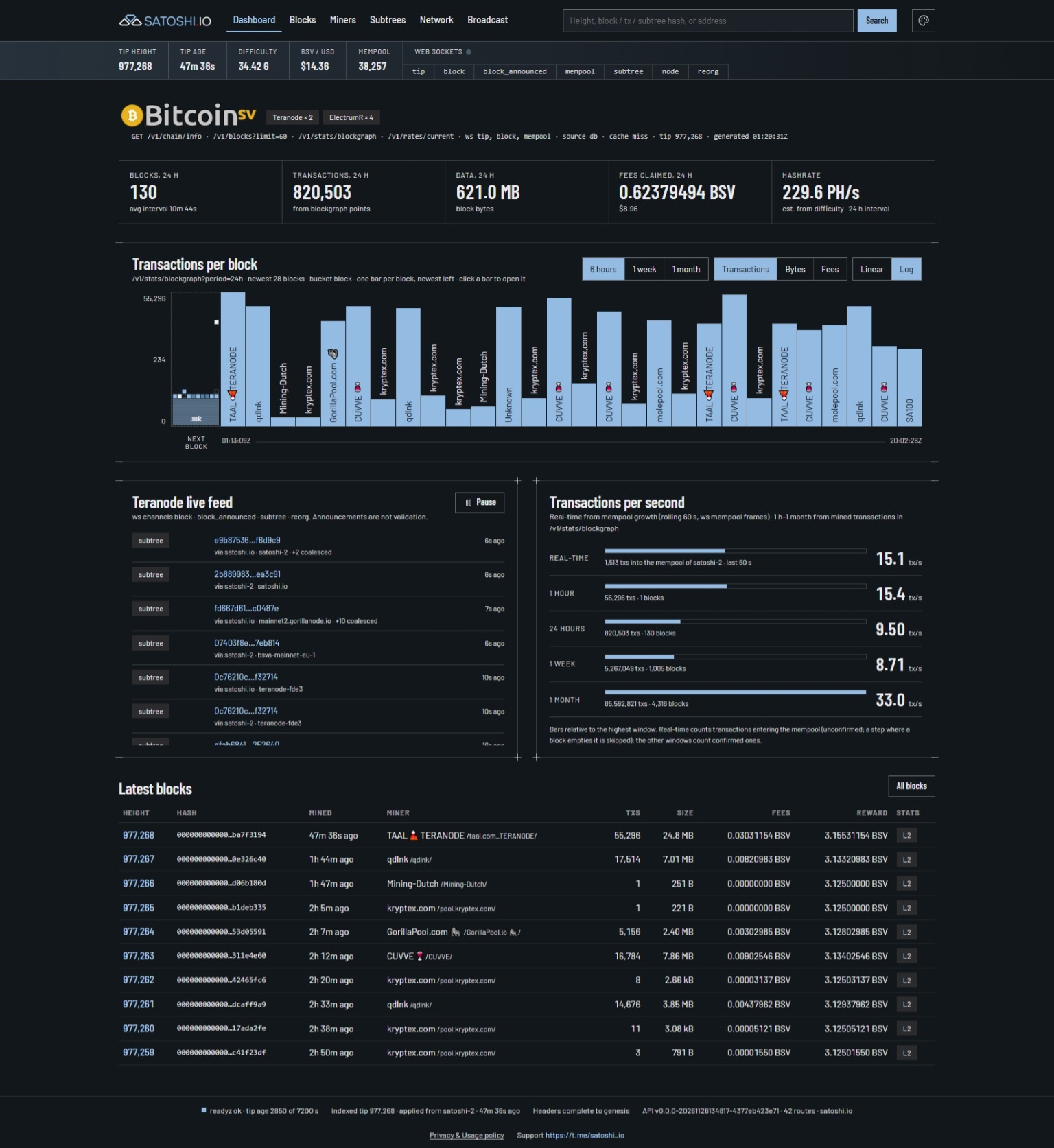
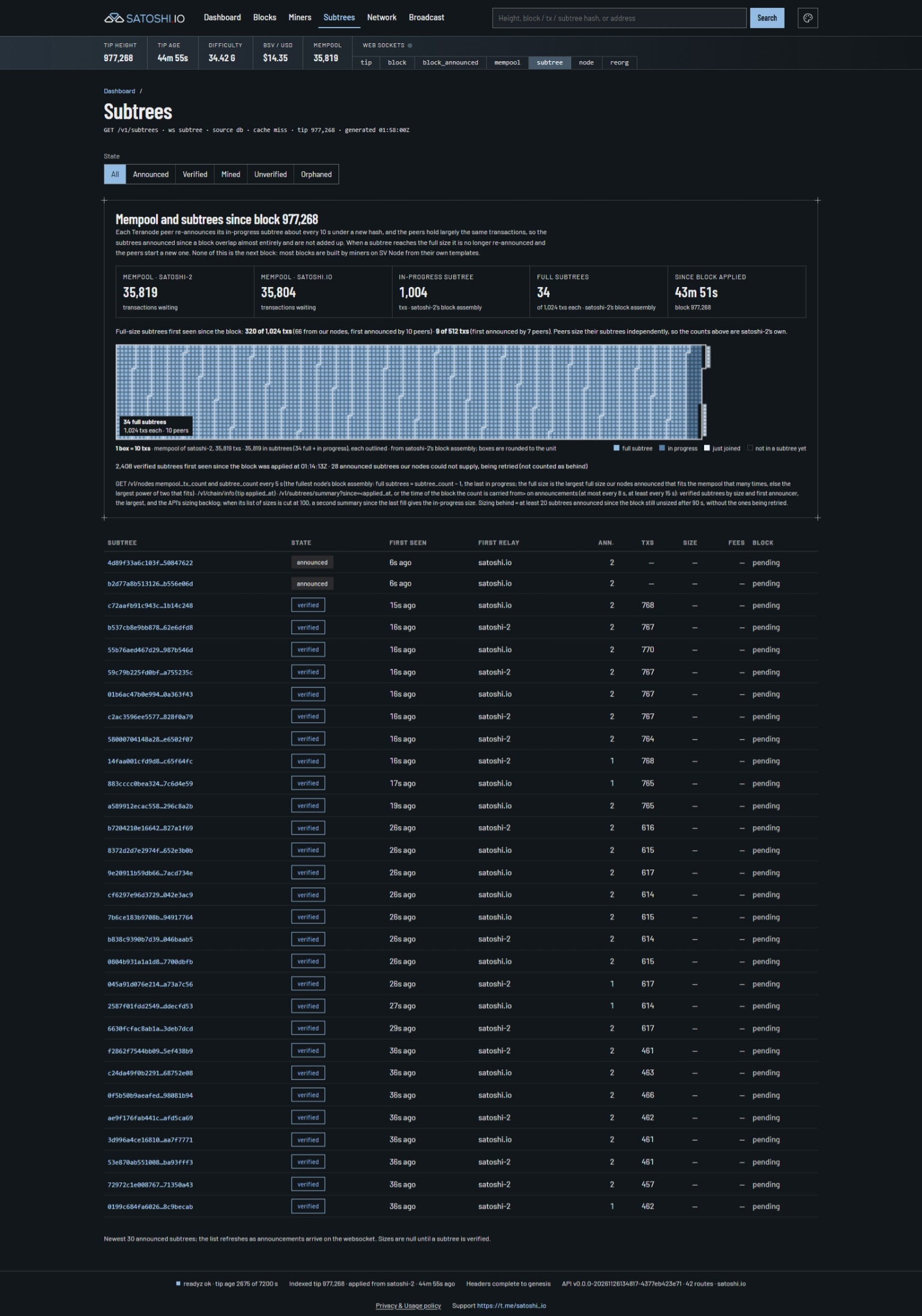
The explorer also provides subtree information associated with individual mined blocks, allowing users to examine this aspect of block construction afterward.
An important distinction is that different Teranode peers may announce subtrees containing overlapping transactions. The total number of transactions represented by these announcements does not necessarily equal the number of unique pending transactions.
The displayed subtrees also do not necessarily represent the contents of the next mined block. They provide visibility into observed network activity rather than a prediction of the next confirmed blockchain record.
Transaction Verification and Broadcasting
The rebuilt explorer also introduces tools for examining transaction inclusion through Merkle proofs.
A Merkle proof provides mathematical evidence that a particular transaction belongs to a mined block. According to Satoshi.io, the explorer recomputes these proofs against the corresponding block’s Merkle root, a value recorded in the block header that commits to the block’s transactions.
This gives users a way to check transaction inclusion rather than relying solely on a displayed confirmation status.
The explorer also supports transaction broadcasting through its web interface, command-line tools, and BSV Broadcaster integration.
Supported submission formats include BEEF, or Background Evaluation Extended Format, which allows relevant transaction information and supporting evidence to accompany a transaction.
These verification and broadcasting capabilities are described in the release announcement but have not been independently tested by BSV TIMES.
Business identification tags are also under development and are not part of the currently announced release.
BSV TIMES Read
A conventional blockchain explorer primarily helps users answer questions about transactions that have already occurred. They can look up a payment, examine a block, or retrieve the history of an address.
Satoshi.io’s rebuilt explorer extends that visibility into some of the activity taking place between mined blocks.
For developers and infrastructure operators, this can be useful when examining how transactions move through the network, how Teranode organizes them, and how observed activity relates to subsequent block confirmations.
As transaction volumes grow, understanding these intermediate stages becomes increasingly relevant. A transaction announcement, its verification by a node, and its eventual inclusion in a mined block represent different stages of processing.
Making those stages more visible can help developers better understand the behavior of applications that depend on timely transaction delivery and reliable confirmation information.
The release also illustrates how supporting infrastructure is adapting to Teranode. Blockchain explorers, indexing services, wallet backends, and monitoring tools must be capable of retrieving and presenting information generated by increasingly large transaction workloads.
The new Satoshi.io explorer provides another publicly accessible tool for examining that infrastructure in operation.
Developer Context
ElectrumR, which powers Satoshi.io’s expanded address histories and historical balance functions, is an Electrum protocol server implementation written in Rust.
Electrum servers provide wallets and applications with an efficient way to retrieve blockchain information, including address histories and available transaction outputs, without requiring each application to maintain its own complete blockchain index.
ElectrumR is designed to handle high transaction volumes through parallel processing, coordinated data retrieval, and database optimizations.
Its source repository and technical documentation are publicly available.
Source Links
Satoshi.io — November 26 Explorer Release Announcement
Satoshi.io — Blockchain Explorer
ElectrumR — Official Website and Technical Documentation
Posted on November 27, 2026 (UTC)

Leave a Reply